

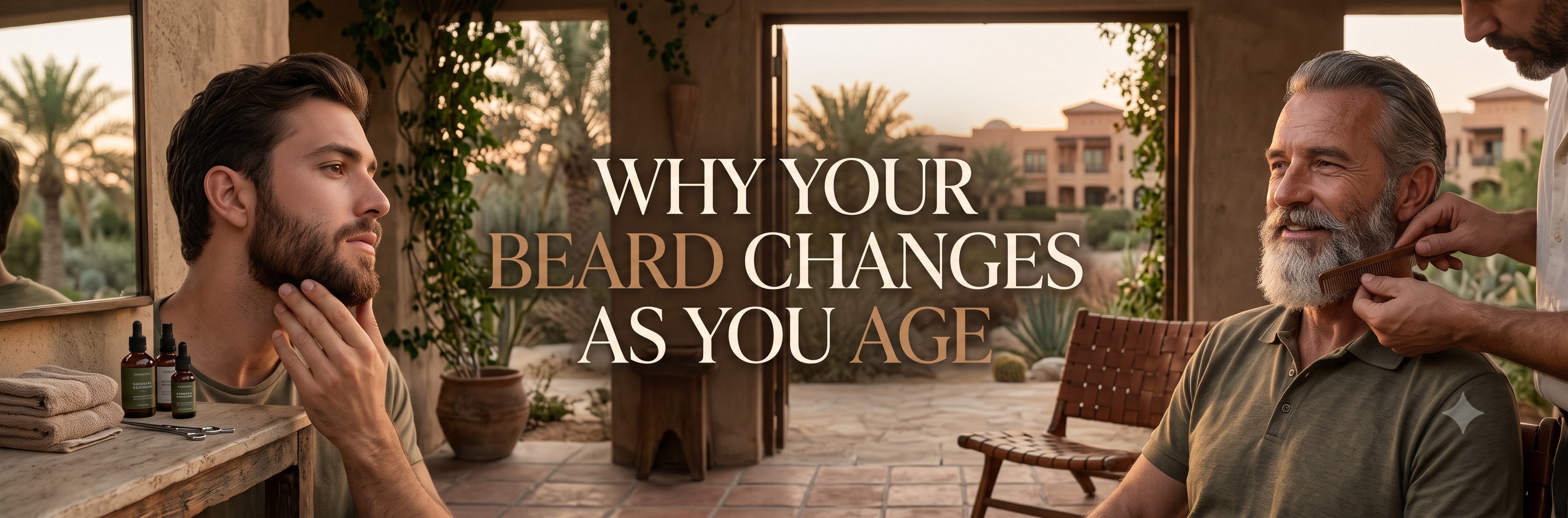
Why Your Beard Changes As You Age
Your beard at 20 may look completely different from your beard at 30, 40, or 50. Changes in density, texture, colour, growth speed, and even the direction of individual hairs are all part of the natural ageing process.
Your beard doesn't necessarily become “worse” with age—it simply changes. Understanding those changes can help you adapt your grooming routine and choose styles that suit your current beard.
Your Beard Can Become Denser as You Mature
Facial hair often continues developing after the teenage years.
Some men notice their beard becoming fuller through their 20s and sometimes into their 30s. Areas that were previously patchy may gradually develop stronger growth.
Genetics and hormones play an important role in determining:
- Beard density
- Hair thickness
- Growth patterns
- Where facial hair develops
- How quickly the beard grows
This is why your beard at 25 may not resemble the beard you had at 18.
Beard Texture Can Change
As you get older, you may notice that your beard feels different.
Individual hairs can become:
- Coarser
- Finer
- More wiry
- Curly or wavy
- Less uniform
It is also common for different parts of the beard to have different textures. Your moustache, chin, cheeks, and jawline may all behave differently.
This means the grooming technique that worked for you years ago may not be ideal today.
Why Does Your Beard Turn Grey?
One of the most noticeable changes is beard greying.
Hair gets its colour from pigment-producing cells associated with the hair follicle. As these cells become less active over time, new hairs can grow with less pigment, eventually appearing grey or white.
Beard hair can sometimes turn grey earlier or more noticeably than scalp hair.
Grey doesn't mean unhealthy. It is a normal part of ageing and can actually add character to a well-maintained beard.
Your Beard May Grow Differently
Age can also change the way your beard sits.
Some men notice that previously straight hairs become more wavy or curly. Others may find that certain areas start growing in different directions.
This can affect:
- Beard symmetry
- Cheek lines
- Neckline appearance
- Moustache shape
- Overall beard volume
A professional trim can help keep these changes under control without trying to completely change your natural growth pattern.
Growth Speed Can Change
Many men associate ageing with slower hair growth, but beard growth is influenced by several factors, including genetics, hormones, overall health, and individual follicle behaviour.
You may notice that your beard doesn't grow at exactly the same rate throughout your face.
For example, the chin may grow quickly while the cheeks remain slower or less dense. This uneven growth can become more noticeable as your beard changes over time.
Your Skin Changes Too
Beard grooming isn't only about the hair.
As you age, your skin can become drier or more sensitive, which may affect how comfortable shaving, trimming, and beard maintenance feel.
A good grooming routine should therefore consider both the beard and the skin underneath it.
Gentle cleansing, appropriate hydration, and regular professional maintenance can help keep the beard area looking cleaner and healthier.
Your Beard Style Should Evolve With You
The best beard style at one age may not be the best style later.
If your beard becomes:
- More grey
- More coarse
- More dense
- Less dense in certain areas
- More irregular in growth direction
your barber can adjust the shape and length accordingly.
Shorter styles may help create a sharper appearance when growth becomes uneven, while fuller beards can work beautifully when density is strong.
Final Thoughts
Your beard is constantly evolving. Changes in density, texture, colour, growth direction, and speed are all natural parts of getting older.
Instead of trying to make your beard look exactly as it did years ago, adapt your grooming routine to the beard you have today.
Call or WhatsApp: +971 557258411